

I could lose every tool I use tomorrow and be back at work by the weekend.
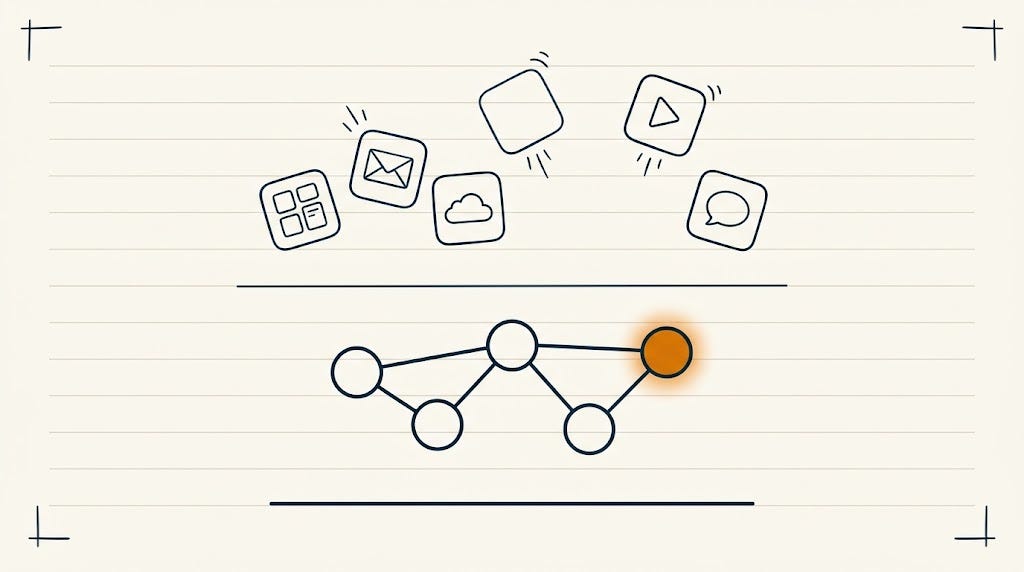
Not because I keep backups. Because none of them holds the thing that matters. The chat app, the task board, the AI model, the place my writing goes. I can throw all of it away and the system I built keeps working.
I set it up that way on purpose. It’s close to the opposite of the advice everyone’s giving right now.
Here’s my system with no product names in it
Five helpers:
One remembers everything and decides what happens next.
One writes and sells.
One looks things up.
One argues with the others and checks whether what they said is true, and it’s not allowed to rewrite anything, so its complaints stay complaints.
One keeps track of what’s waiting on me.
Work shows up and becomes a card. Every card says who it’s for, what it’s for, and what’s happened to it so far. Every single action gets written down as one line: the card, the action itself, who did it, and when.
Nothing goes out to real people without me. On the path that messages strangers, that gate is strict in a specific way: the send tool looks up each message and refuses unless it finds a yes recorded by a person, and a yes written by a tool is thrown out. On the publishing path, it’s a quieter thing: a button only I can reach.
Different strengths, same rule.
Read that again and notice what’s missing. No brand names. No AI model. No app.
Two of those five have been running for months. The other three are new, added in the last few days, and here’s the part that matters: adding them didn’t change the description. It also didn’t change when I swapped what runs underneath. A design that can absorb three new workers, and a change of model, without being rewritten is the thing I’m actually claiming.
The question everyone asks stops being true very fast
Open almost any newsletter like this one and you’ll find the same article: here are the tools to use, here’s the stack to copy, here’s the fourteen things that will put you ahead.
I actually read a really good one this week. It listed the exact tool for fourteen different jobs.
It’ll be wrong within a year. The person who wrote it knows that, which is why he writes a new version every few months.
Tools change fast. Prices go up. A better one shows up. The one you learned gets bought by a bigger company and slowly gets worse. Enshittification is real. If your business is a list of products, you have signed up to redo the work every time the list changes.
The layer underneath the tools barely moves at all.
What I could throw away this afternoon
This isn’t a thought experiment. These are things I’ve already changed, or could change today.
The chat app: work shows up as messages, whether that’s Discord or Teams or an email inbox. Changes one small piece of code.
The task board: cards, columns, comments, done. That’s Asana, or Trello, or Linear, or the one I use - Fizzy, by 37Signals.
The AI model: today that’s Claude, and I like it. I’m using Anthropic’s Fable and Opus and Sonnet for the right-sized tasks for those models. My helpers are described in plain writing, so what runs them underneath is a setting. If something better arrives next year I change the setting, and every one of them still knows what it’s for.
The places I publish: Substack, LinkedIn and X are all driven from a browser I’m already signed into, so none of them has me locked in through a connection I would have to rebuild. When Substack added a scheduler for Notes, switching to it took one morning, because my system already knew what a scheduled piece was.
The part I couldn’t throw away is the part nobody sells you: what each helper is for. The rule that one of them may never rewrite another one’s work. The single gate that needs a human. Those took real thinking. They’re also just words in files I own.
Your history should belong to you
The clearest example is where my writing lives.
Every piece I have written, drafted, killed or published is a list of lines in a file in my own folder. Just over a thousand pieces across 222 days. 636 of them went out. Every change is one line with a time and a name on it.
The searchable copy sitting on top of that file is throwaway. I delete it and rebuild it from the lines whenever I feel like it, and I have.
If that history lived inside somebody’s app instead, I’d be renting my own memory. Most people make that trade without noticing, because the app is genuinely good and there’s an export button right there in the settings.
Why almost nobody talks about this part
There is nothing to buy.
Nobody advertises “spend an afternoon deciding what each part of your business is actually for.” It doesn’t look good in a screenshot.
It’s also harder. Comparing tools takes twenty minutes and feels like progress. Writing down exactly what you want, clearly enough that the right tool becomes obvious, takes an afternoon and feels like you didn’t do anything at all.
So everyone writes the tool article. It’s quick to write, quick to read, and somebody buys something at the end.
I’m not against those articles. I wrote one this week. But it answers a question that expires, and the reason mine keep working is that I answered a slower question first.
The one question I ask before adding anything
What happens to my system if this exact product disappears in eighteen months?
If the answer is that one small piece of code changes, it goes in and I barely think about it.
If the answer is that my history lives inside it, or that the way I work would be shaped by its buttons? Then it doesn’t go in. Or it goes in, and I keep my own copy of the record somewhere I own.
That question has kept me away from products that were better than the ones I use. It was worth it every time. A slightly worse tool that leaves you holding your own history beats a better one that holds it for you.
Try this before you pick anything else
Write down how your business works on one page, without naming a single product.
Who does what? What decides what? What has to be written down? Where a person is required, and why it has to be a person there?
Most people can’t finish that page on the first try. That’s the useful part. Every place you get stuck is a decision you have quietly handed to a product.
Then, go and pick your tools. You’ll find the choice is much easier, and much less interesting, which is exactly what you want.
PS. If you want a resilient setup for your own business, I can help.