

The trap you might not know you’re in
Here’s something that surprised me when I actually sat down and counted: I was paying monthly fees to eleven different software companies. Email tools, automation platforms, database services, payment processors, scheduling apps. Eleven separate bills showing up every month like clockwork.
And I don’t think I’m unusual. Most people who build anything online probably have a similar stack of monthly fees. Whether you’re running a business, creating content, or selling courses. Maybe more subscriptions than you’ve counted. Each one feels small. Twenty bucks here, fifty there. But they add up.
The thing that started bothering me wasn’t the money, though. It was the realization that I don’t actually own any of it.
Every tool I use belongs to someone else. They set the prices. They decide when to change features. They can triple their rates tomorrow, or shut down entirely, and I’d just have to deal with it. I’m renting my entire business infrastructure from companies that don’t know I exist.
I started asking myself an uncomfortable question: What would happen if any of these tools suddenly cost three times as much? What would I do?
For most of them, I didn’t have a good answer.
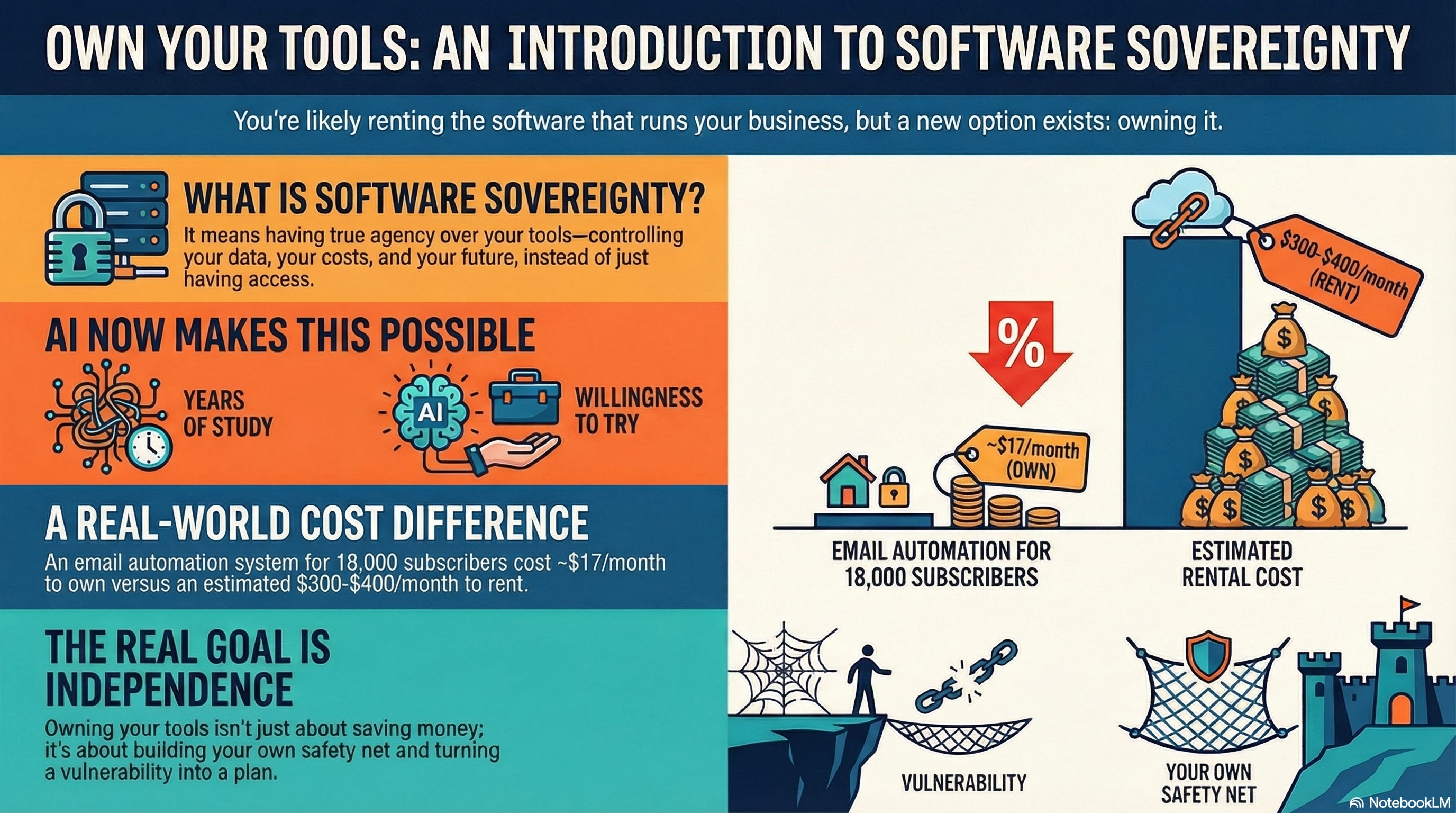
What is Software Sovereignty?
I’ve started calling this idea Software Sovereignty. It’s not a common phrase, and that’s intentional. I needed a name for something I was thinking about that didn’t have good language yet. I’ve seen similar terms, such as digital sovereignty, being used at a national level in some cases, where countries are trying to be more “digitally independent” from corporate control (collaboraonline.com/blog/openmatters004).
Digital sovereignty, cyber sovereignty, technological sovereignty and data sovereignty refer to the ability to have control over your own digital destiny – the data, hardware and software that you rely on and create.
Or, as the Centre for Africa-Europe Relations puts it: the physical layer (infrastructure, technology), the code layer (standards, rules and design) and the data layer (ownership, flows and use).
Software Sovereignty, in my case or the case of our brands and businesses at a more local level, means having agency over your tools, not just access to them.
It means owning your own data so you can take it anywhere. It means controlling your costs in a way that doesn’t scale against you as you grow. It means understanding your systems well enough that if something breaks, you can fix it. And it means having the freedom to change things when your needs evolve.
Here’s what Software Sovereignty is not about: being cheap. I’m not interested in penny-pinching my way through building a business. Life’s too short, and my time has value.
And here’s the other thing it’s not about: becoming a programmer. I’ve written software professionally for twenty years, so I obviously have that background. But the version of this I want to share doesn’t require you to become a developer. It requires you to stop being trapped.
This connects to something I think about a lot. I don’t wait for companies or institutions to protect my future. I build my own safety net. And renting every piece of software that runs my business means depending on companies that could pull the rug out from under me at any time.
That’s not a safety net. That’s a hope.
Why this is possible now
Five years ago, if I told you to run your own tools instead of renting them, you’d need serious technical skills. You’d be reading dense documentation, learning arcane commands, troubleshooting obscure error messages. It would take months just to get something basic working. Maybe years to get comfortable.
The barrier was real. Building your own stuff required knowledge that took a long time to acquire.
AI changed that equation. Not completely (I want to be honest about this), but substantially.
Now you can describe what you want in plain English. You can say “I need to set up a system that sends automated emails when someone signs up for my list” and get back actual instructions. Specific steps. Real guidance. When something breaks, you can paste the error message into a conversation and get help understanding what went wrong.
The barrier dropped from “years of study” to “willingness to try and ask questions.”
I don’t want to oversell this. There’s still a learning curve. You’ll hit walls. You’ll get confused. Some days you’ll wonder why you didn’t just pay the monthly fee and move on with your life.
But the curve is shorter than it’s ever been. And for the first time, this option exists for people who aren’t professional developers. Not in theory. In practice.
What this looks like in practice
Let me tell you what happened when I actually tried this.
I have about 18,000 students in my online courses. They signed up through the course platform, but that platform owns the relationship. If I want to email them directly, to share updates or offer new courses or just stay connected, I need to bring them onto my own email list.
So I looked up what that would cost.
The email software most creators use would charge me somewhere between $145 and $155 per month for a list that size. That’s just for email. Add automation tools for workflows (when someone clicks this, do that), a database to track who’s interested in what, and monitoring to know if something breaks? I’m looking at $300-400 per month easily. Some people pay much more.
That’s $3,600-4,800 per year. For software I don’t own. For data I can’t fully control. For tools that could change their pricing whenever they want.
I decided not to pay it.
Instead, I spent a few days building my own system. Email sending, automation workflows, a database I control, monitoring that tells me when something goes wrong. All of it running on my own setup.
Total monthly cost: about $17. $21~25 if you add any volumes or enable backups, per Hetzner’s pricing. $32 for my specific case with my configuration and with a few more servers hosting other apps I’ve developed, and just to be transparent - but still significantly less than hundreds to thousands of dollars per month.
Let me be clear about something. This wasn’t easy. I hit obstacles. I made mistakes. The company I needed for email delivery rejected my application twice. Both times, manual rejections from actual people with no explanation. The second rejection even included “thank you for your understanding”—as if there was anything to understand when they’d told me nothing. I pushed back. Told them no, they didn’t have my understanding, and demanded an actual reason so I could address whatever the issue was. A couple of days later, they approved me. I changed nothing. They never explained. Bureaucratic friction is part of the game.
But now I have something that works. Something I own. Something that won’t suddenly cost me ten times more because a company changed their pricing tiers.
And I learned things along the way that will help me build whatever comes next.

This might not be for you
I want to be careful here. I’m not saying everyone should do this.
Some people are at a stage where the learning curve isn’t worth it. You’re in the middle of launching something, or your business is already humming along, or you genuinely don’t care about this stuff and your time is better spent elsewhere. All of that is valid.
But here’s what I do think: you should know this option exists.
Most people don’t. They assume that using business software means paying monthly fees forever. They’ve never considered that there’s an alternative. And because they don’t know, they never evaluate whether the rental makes sense or whether they’d be better off owning.
Software Sovereignty isn’t about everyone building everything themselves. It’s about having the knowledge to make a real choice. Knowing which tools make sense to rent and which ones make sense to own. Understanding the tradeoffs.
Once you see this, you can’t unsee it. Every time you sign up for a new tool with a monthly fee, you’ll find yourself asking: Could I own this instead? What would that cost me in time? What would it save me in freedom?
Sometimes you’ll decide the rental is worth it. I still rent plenty of software. But you’ll be making that choice consciously, not by default.
If you’re curious about how this works, I’m going to be sharing more of it. The thinking behind it, the actual steps, the places where I got stuck and how I got unstuck. Not as a course or a product. Just as part of building in public and showing what’s actually involved.
Follow along if you want. Ask questions if you have them. Try things if you’re ready.
What Software Sovereignty really means
At the end of all this, Software Sovereignty isn’t really about software. And it’s not really about technology.
It’s about independence.
It’s about recognizing that every system you depend on but don’t control is a vulnerability. A point where someone else makes decisions that affect you. A place where you’re hoping for the best instead of building for it.
I think a lot about what it means to build your own safety net. To take ownership of outcomes even when the reasons things go wrong aren’t your fault. To have skills and systems that let you adapt when circumstances change.
Owning your tools is part of that. Not because it saves money (though it does). Not because it’s technically interesting (though it can be). But because it gives you options. Because it means one less company can hold your business hostage. Because it turns a hope into a plan.
That’s what G8N•AI is about, ultimately. Teaching agency through building. Showing that the things that feel locked away (technical skills, infrastructure, independence) are more accessible than they look.
You don’t have to become a software developer. But you can stop being trapped by software.
And that changes more than you might expect.
If this resonated with you, subscribe to G8N•AI for more on building with AI, owning your tools, and creating the kind of independence that lets you focus on work that matters.
PS—I help founders replace their $400+/month SaaS stack with self-hosted tools they actually own. Two weeks. Complete setup. Training sessions so you understand what you have. You keep the savings forever.
If Kit’s 35% price hike made you wince—or if you’re just tired of feeling trapped by tools you don’t control—book a call and let’s talk about what sovereignty looks like for your business.
This is part of what I’m calling “teaching agency through building.” That’s what G8N•AI is about.