


I skipped last week’s issue because I was in Austin for the Business Author Summit, so this one’s a double. It’s also the longer explainer I keep saying I’ll write, the plain-English one on getting found when people ask an AI instead of searching.
If you run a small business, you’ve probably heard SEO, AEO and GEO tossed around like they’re three separate emergencies. They’re closely related, and one taco stand can explain all of them.
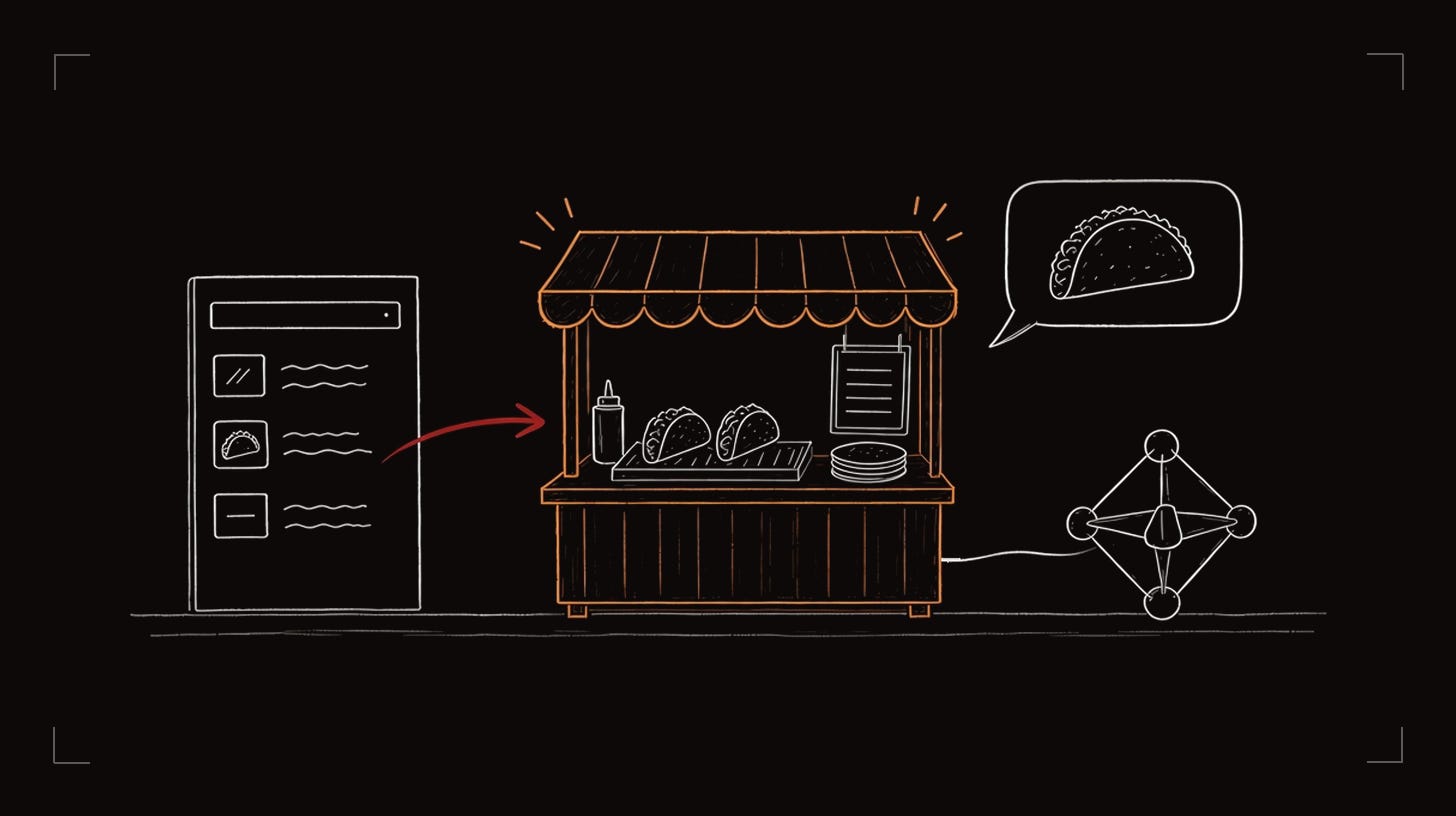
Imagine you run a taco stand.
SEO is making sure your sign is big enough to be seen from the highway.
AEO is making sure that when someone yells “Where are the tacos?!”, you’re the first one to yell “Right here, $3 each!”
GEO is making sure that when the local food critic (the AI) writes a summary of the town’s food scene, they say, “While there are many options, the consensus is that the al pastor at [Your Name] is the only one worth eating.”
That’s the short version. I’ll use the same stand the whole way through. For each layer you’ll get what it is, the simple fix, and what to tell your own AI so it does most of the legwork.
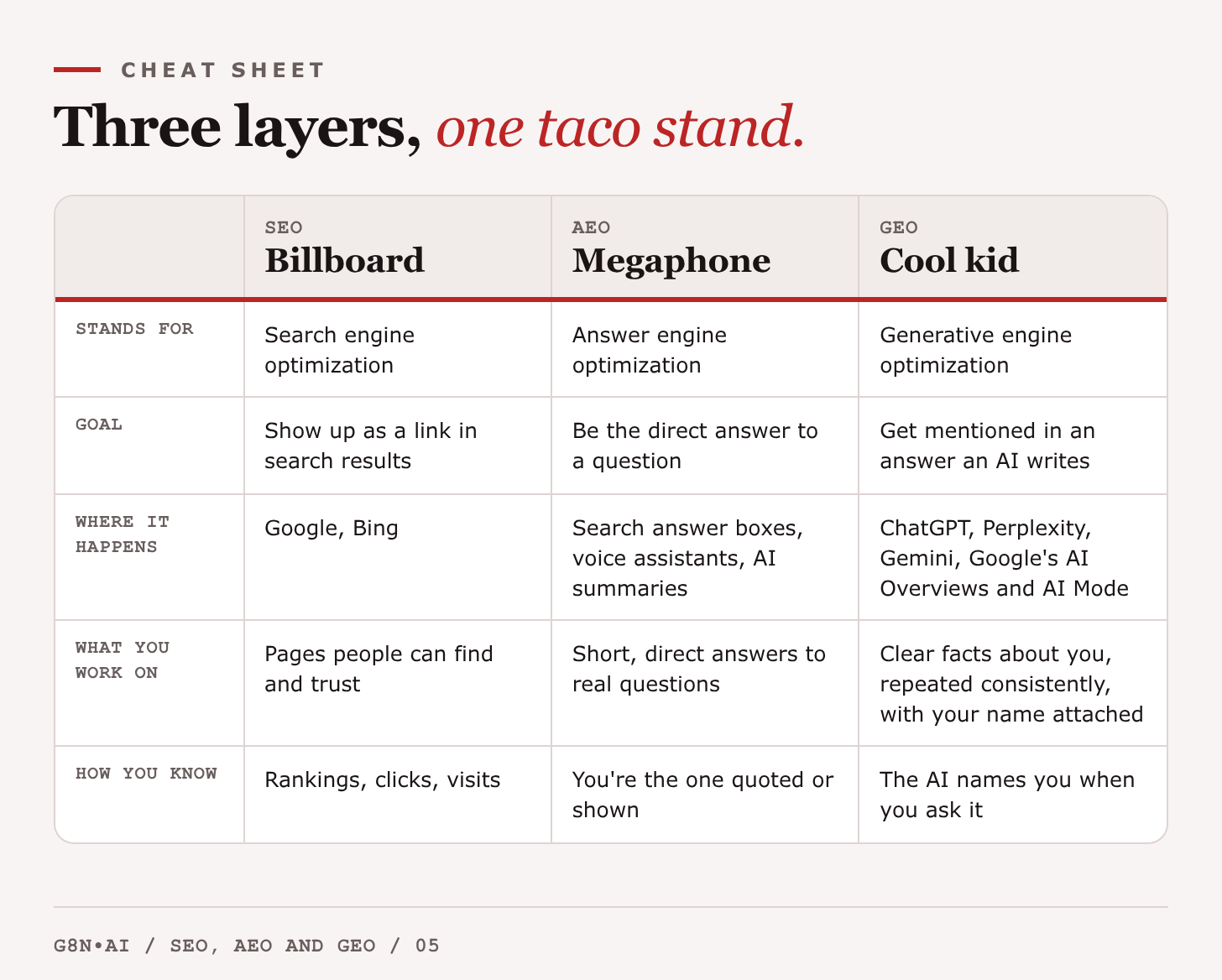
A quick note on the names. They overlap, and different people use them in different ways. Google’s own guidance on its AI features says the SEO basics still apply, and that there’s nothing extra you have to add to show up in AI Overviews or AI Mode. So I treat AEO and GEO as a way of deciding what to check, more than as three separate jobs.
SEO is the billboard
Think of the billboard by the road. It works if it’s in a good spot, people can read it, and enough of them drive by. It doesn’t tell anybody much. It points at you, and they have to come find you.
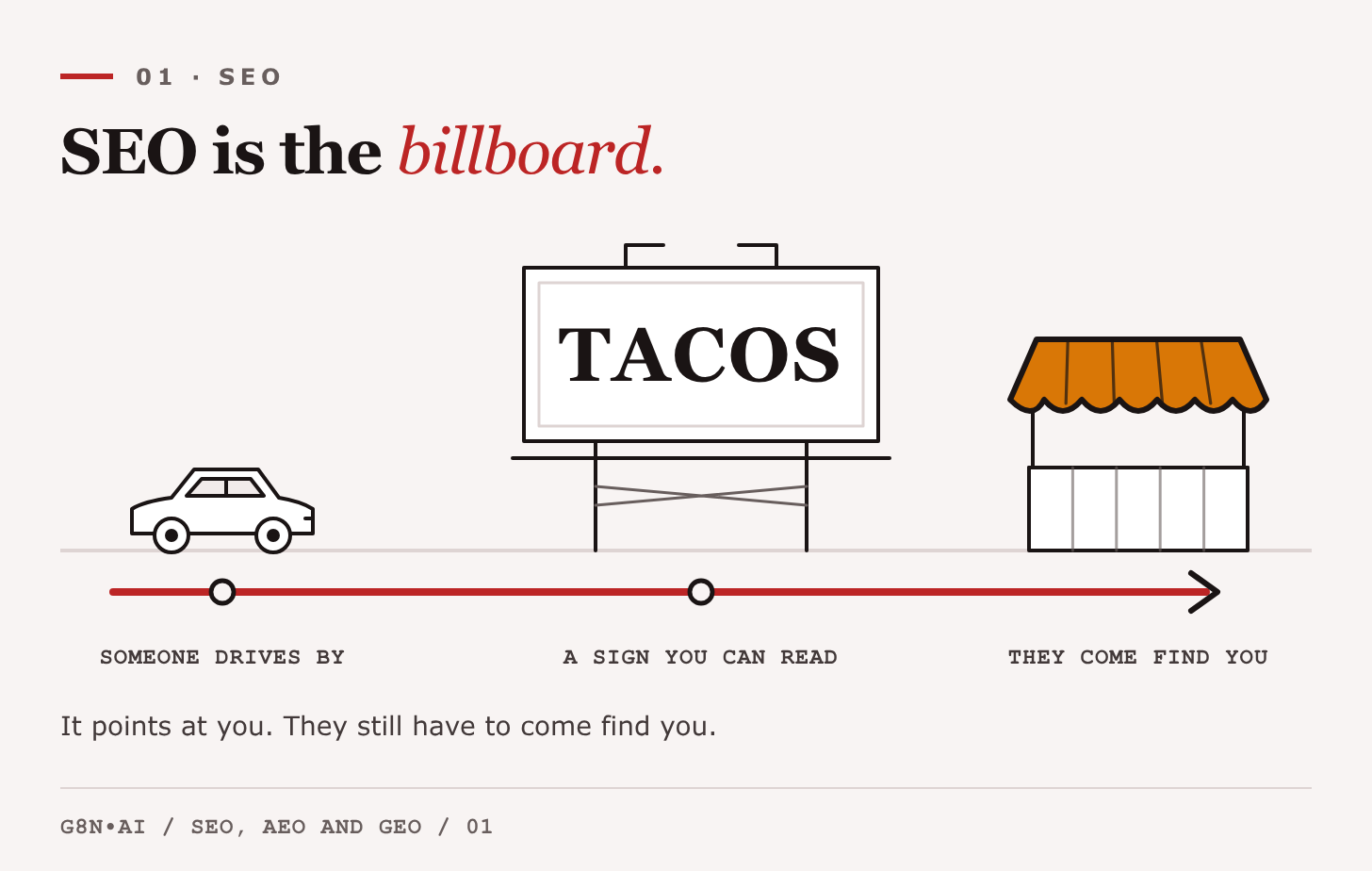
Search results work the same way. Someone types “tacos near me” or “taco stand” plus your city, Google shows a list of links, and you want to be on that list and look like the right pick.
For a long time, that was most of the job, and some of the old shortcuts got pretty sloppy. Stuffing the same words over and over, or trading links just to rank, are things Google now treats as spam. The useful version’s still pretty simple. Make the business easy to find, and make it obvious what you actually offer.
The simple fix
Fix your Google Business Profile. Hours, address and phone should be right, and the menu link should work. Google specifically lists keeping Business Profile information up to date as part of the basics.
Put your menu on your website as text, not only a photo or a PDF. Google says important content should be available in text form.
Make sure search engines are allowed in. If your site has a robots.txt file that blocks crawlers, or your page isn’t indexed, nothing else matters. A quick check is to search your exact business name and see if your site comes up.
Give each thing its own page. Menu, location and hours, catering. Link between them.
That’s most of it, and it’s pretty boring, which is fine.
What to tell your AI
Copy this: Here’s my website: [your URL]. I run a [type of business] in [your city]. Act as a local search consultant and look at the site for basic problems. Check whether my menu, hours and address are written as text a search engine can read, whether each of my main offerings has its own page, and whether anything looks like it’s blocking search engines. Give me the five most important fixes in plain English, easiest first. Don’t rewrite anything yet.
If your AI can’t open web pages, paste the text of your homepage in under the prompt instead.
AEO is the megaphone
Now picture someone in the crowd shouting a question, and you’re the one who shouts the answer back, quickly and clearly. A billboard doesn’t help anyone who just asked a question out loud.
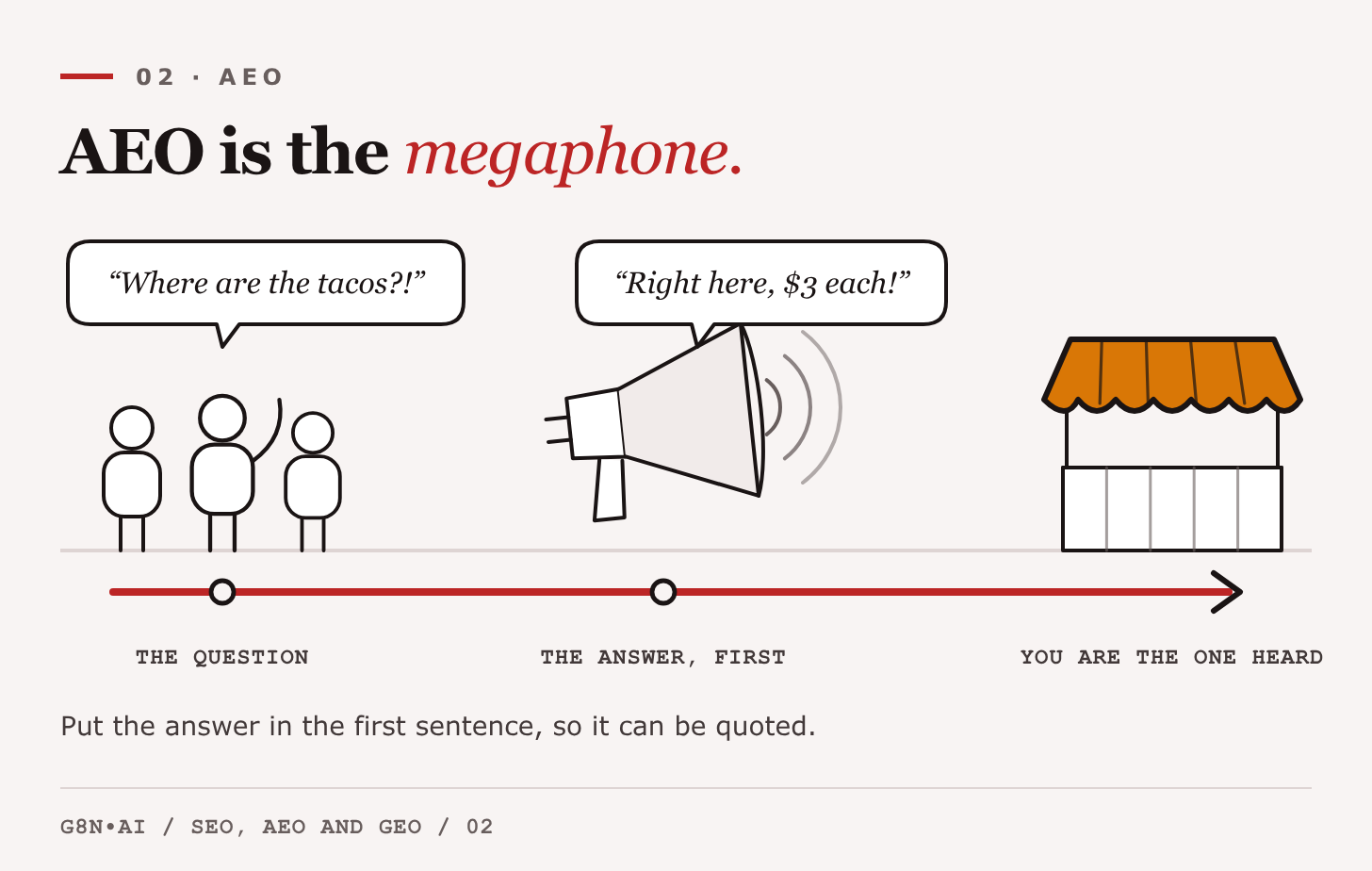
That’s the idea behind AEO, or answer engine optimization. The older, clearest example is the featured snippet, the box Google sometimes puts at the top of the results with a short answer taken from one page.
The simplest example I know is an egg.
The SEO way: “Here are 10 links about how to boil an egg.”
The AEO way: “Boil it for 6 minutes for soft, 12 for hard. Next!”
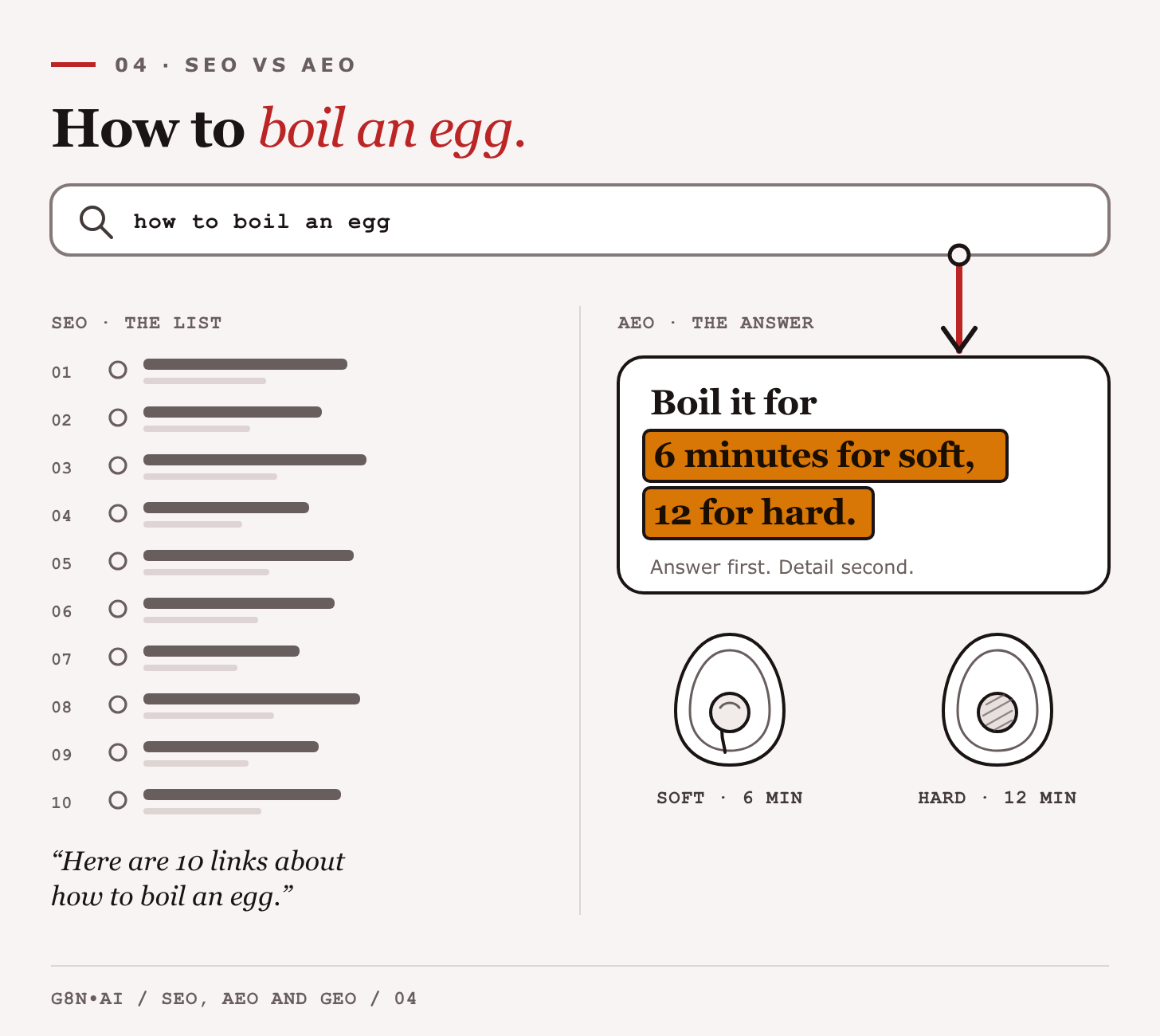
Someone asking that question wants the answer in the first line, and then, if they’re curious, the details about soft versus hard. Search engines and AI tools both tend to pull from pages that are built that way.
People now use AEO more loosely for any situation where the answer is shown directly, including voice assistants and some AI summaries. I wouldn’t get too hung up on the label.
For the taco stand, think about what people ask you at the window. Are you open late? Do you have vegetarian options? Do you take cards? Can you cater a party? Those same questions are what people type into a search box or ask an assistant. If your website answers them in plain sentences, you can be the one quoted. If the answers only live in your head, you can’t.
The simple fix
Write down the ten or fifteen questions customers actually ask you.
Put them on your site, one question per heading, with the answer in the first sentence. “Yes, we have vegetarian tacos. They’re...” and then the details.
Only answer what you can really answer. A heading that asks a question the section doesn’t answer doesn’t help anyone.
Keep the answers short enough that someone could read one out loud.
What to tell your AI
Copy this: I run a [type of business] in [your city]. List 15 questions a customer might ask before choosing a place like mine. For each question, write a direct answer in one or two sentences, with the answer first. Use only the facts I paste below. If you need a fact I haven’t given you, write [NEED FROM OWNER] instead of guessing. Here are my facts: [paste your hours, menu prices, payment types, catering info, anything else true about the business].
That last instruction matters. An AI will happily make up your opening hours if you let it, so tell it not to.
GEO is the cool kid at the party
The last one’s the hardest to picture, so think of a party where somebody asks the room, “Anybody know a good taco place around here?” Nobody’s shouting, and nobody’s pointing at a sign. A few people just say your name because they know you and it came to mind.
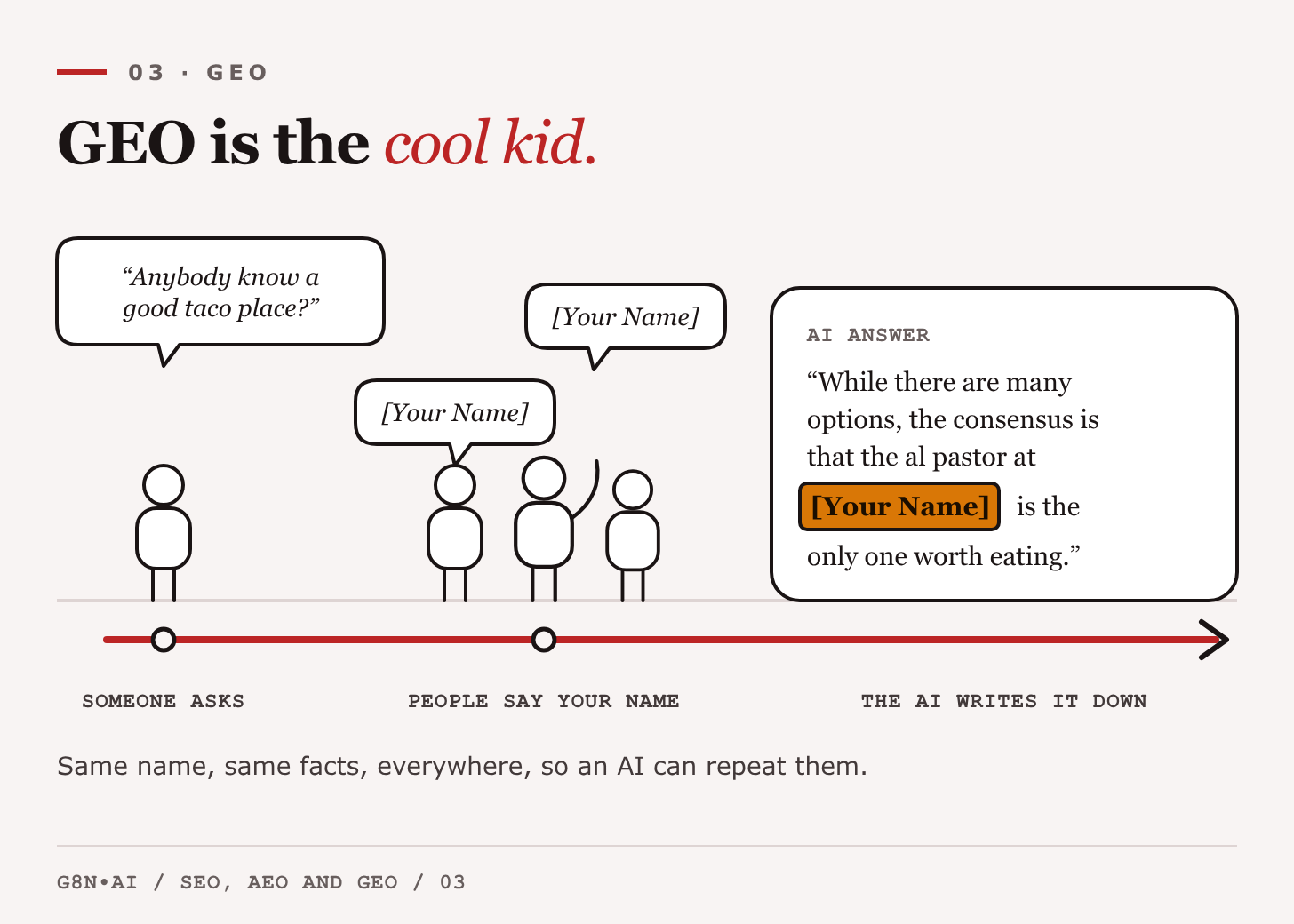
If SEO is a billboard, and AEO is a megaphone, GEO is like being the cool kid at the party that everyone quotes. The name comes from a 2023 research paper by people at Princeton, Georgia Tech, and the Allen Institute for AI, and IIT Delhi. In practice, it’s the work of getting mentioned when an AI writes an answer.
These tools don’t read the entire internet and write you a custom essay. When someone asks ChatGPT, Perplexity or Gemini a question that needs current information, the assistant often searches the live web first, reads a handful of pages, and writes a short answer with a few names and links in it. You want to be one of those names.
For the taco stand, say someone asks, “Where should I get tacos for lunch near the convention center?” The AI looks at your site, your reviews, local articles and listings. If those places agree on who you are and what you’re known for, it’s easier to say your name. If your hours are different on three sites and the menu is a blurry photo, there isn’t much for it to work with.
I write about the naming side of this in September in AI Will Cite You Without Ever Naming You. The short version is that an AI can use your page and still never say your name, so it helps to put your name in the sentences that matter.
The simple fix
Use the same business name, address, hours and one-sentence description everywhere. Your website, Google, Yelp, Facebook, any local directory.
Say what you’re known for, in specific words. “[Stand name] serves [the thing you’re known for] at [where you are]” is a better sentence for an AI to repeat than “come see us for great food.”
Check your robots.txt. OpenAI has a crawler called OAI-SearchBot that it uses for ChatGPT’s search results, and Perplexity has PerplexityBot for its search results. Those are the ones you want to allow if you’d like to show up. OpenAI’s GPTBot is a separate one used for training its models, and blocking it is a different decision. Blocking the search ones can keep you out of the written answers, though a regular link to you might still show up in some cases.
Ask the assistants about yourself now and then, and write down what they say.
What to tell your AI
First, a test. Use an assistant that can search the web.
Copy this: I run a [type of business] called [name] in [your city]. Search the web and answer these as if you were recommending a place to a stranger: “Where’s a good [type of business] near [neighborhood or landmark]?”, “What’s the best [type of business] in [your city] for [a quick lunch / a family dinner / catering]?”, and “What do people say about [name]?” Tell me whether you mentioned my business, who you mentioned instead, and what sources you used. Then tell me what information about my business was missing, out of date or inconsistent.
Then, a fix. This one writes the description you’ll reuse everywhere.
Copy this: Write a short description of my business that I can use on my website, my Google profile and my other listings. Include the name, the location, what we do, and what we’re known for, in plain words. Write one version of about 25 words and one of about 75. Use only these facts: [paste your facts]. Don’t add anything I haven’t told you.
And one for the robots.txt check, if you’re not sure what yours says.
Copy this: Here’s the contents of my website’s robots.txt file: [paste it, or paste yourdomain.com/robots.txt]. In plain English, tell me whether it blocks Googlebot, OAI-SearchBot or PerplexityBot, and what I’d change if I wanted all three allowed.
How I’d actually do it
If I had a taco stand and one afternoon, I’d start with the Google Business Profile and the menu text, because that’s the SEO layer and the other two sit on top of it. Then I’d write the question page with the AEO prompt. Then I’d run the GEO test and see what the assistants say. It’d probably show a few gaps I hadn’t thought of.
One habit from my own setup carries over here. I run a lot of my business on AI agents, and I approve every piece myself before it goes anywhere. Do the same with anything your AI writes for your site. Read every line, especially hours, prices and anything that sounds like a claim, before you publish it.
What I’m not claiming
Nobody has a formula that makes an AI recommend you. Anyone who says they do is ahead of what’s known. AI search is changing quickly, and what’s true of one assistant may not hold for the next. Google’s published guidance and the crawler documentation from OpenAI and Perplexity are the most solid sources I’ve found, so that’s what the technical parts above are based on. The rest is my own judgment about what’s worth testing.
I’ve said a few times that I’d get into AEO and GEO properly, and this is the first plain-English pass at it. If you try one of these prompts on your own business, reply and tell me what the AI said about you. I’m curious which layer people turn out to be weakest on.
I’m Ahad Amdani, and this is G8N•AI. If you’re interested in having a conversation about how I can help you with your AI visibility, let’s have a chat.
Ahad, the ten or fifteen real customer questions with the answer first is exactly what we see at HEA-World, where the business's own website becomes the source its AI answers from.
The egg answer works because it fits in one sentence. A GEO claim that needs a paragraph will never survive the quote.