

All of my writing is AI. I’m proud of it. So what?
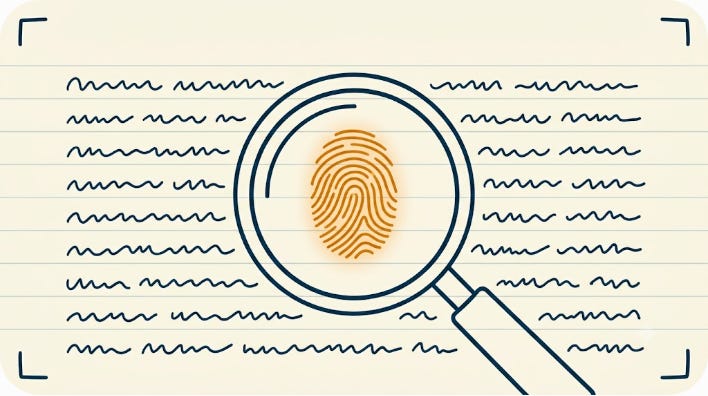
Recently, Substack gave every reader a reason to ask. They shipped a button that scans any post and estimates how much of it a machine wrote, built on Pangram, one of the sharper detectors out there. Open one of my newsletters, tap scan, get back a number. If it’s high, some readers will close the tab.
Good. Let them. I’m not writing for the people counting my keystrokes. I’m writing for the ones who want something worth reading.
But “all of it is AI” is easy to misread, so I’ll be precise about what I’m actually claiming, and where I think the scanner gets it badly wrong.
What the scanner actually sees
Pangram is good at its job. I’ll give it that, and so will people far more adversarial than me. Limited Edition Jonathan, a writer I follow who makes a kind of sport out of beating tools like this, put it bluntly: it’s annoying, he finds it unethical, and he still hasn’t found a way to beat it. It’s accurate. I believe him.
Accurate at what it measures, though, is the catch.
It tells you a machine touched the words. It cannot tell you whether a person cared. It can’t see the months and years I spent learning what a sentence is supposed to do. The four passes I made stripping out every line that sounded like a robot are invisible to it. So is the fact that the idea underneath the piece is one I’ve been turning over for a decade. It sees texture, calls that texture “AI,” and a certain kind of reader treats “AI” as a reason to leave.
Substack’s own CEO, Chris Best, drew the line in a more honest place. He put the weight on ideas over words. Using a tool to get the words down is fine. The offense, in his framing, is passing off thinking you never did as your own. I agree with that completely. The thinking has to be yours. On that test, I’m not nervous about a scanner. I’ll take it.
How this newsletter actually gets made
Substack now suggests writers add a note explaining how they work. Happy to. Here’s mine:
I don’t sit down to a blank page. A model writes the first draft, fed on a pile of my own writing, my rules, and the list of things I refuse to say. Then the real work starts. I (or rather, now, my AI) cuts the generic lines, adds the specific number the model didn’t have but the context supplied, and kills every sentence that reads like it came off an assembly line - and there are always a lot of them, because that’s what first drafts are. What survives has to clear a filter I built that hunts down over thirty separate tells of machine writing. Only then does a human, me, read it end to end and decide whether it’s worth your inbox.
Call it the 80/20 split (moved from the 70/30 I used to tout). The AI does about eighty percent of the volume. The twenty percent I supply — the direction, the taste, the judgment, the deletions, the one true story — is where the entire value sits (and I manually added these em dashes, too bad Mr. AI Detector). Take that twenty out and you get slop, and you’d be right to close the tab. Leave it in and you get something I’ll put my name on.
That’s the part the scanner can’t grade. It counts the eighty. It has no field for the twenty.
The line I actually hold
I use AI for almost everything I ship. I also know exactly where I stop trusting it, and that line is the whole point.
Last week I wrote about the three checks I run before I trust anything a model hands me. The scanner news makes them matter even more, so here’s the checklist itself. Keep it near your desk.
Before you ship or send anything AI touched, ask three things, in order:
If this is wrong, can I undo it easily?
Does the cost of being wrong here justify how hard I’m checking?
Do I actually know it worked, or am I trusting a “done” message?
Most things pass all three in a couple of seconds. Editing a paragraph is reversible and low stakes, so you barely look. The moment something is permanent, or touches money, or touches another person’s data, the checklist tells you to stop and read it like your name is on it. Because it is.
That third check is the one almost nobody runs, and it’s the one that saves you. A tool saying it worked and the thing actually working are two different facts. I learned that watching one of my own tools print “POSTED” for a LinkedIn post that never went live, with a screenshot of somebody else’s feed saved as its proof. Now I look at the thing itself, not the log. Did the post appear on the profile. Is the file actually in the sent folder. Is the row really in the database when I go look.
That’s the bar. The bar isn’t whether a human typed every word. It’s whether a human owned the judgment. A scanner can’t see that. You can.
I promised that full checklist last week, and it’s yours. The complete version, with the reversibility triage, the over- and under-checking trap, and the verify-it-yourself list, lives here.
Where I get off the purity train
The reactions to Substack’s button split the way you’d expect, and the split is worth watching.
Some writers are treating the number like a verdict. High AI, low value, case closed. Karo (Product with Attitude), who writes Product with Attitude, pushed back with a whole essay arguing the binary itself is broken. There’s a missing category, she says, between “human-made” and “AI-made,” and most careful work now lives there. She calls it AI-assisted craft. I think she’s right. The scanner offers two boxes for a job that clearly has three.
Then there’s the harder objection, the one I keep circling back to. Limited Edition Jonathan, the same writer who admitted Pangram works, pushed the purity test to its logical end. Disclose your ghostwriter next. Then your spell-check. Then the operating system you typed on, and the way you did your research. Once “real writing” means “no machine touched it,” the standard quietly eats everyone, because a machine has touched all of it for years.
I don’t want to live on that side of the line. I’d rather tell you exactly how the work gets made, which I just did, than pretend a tool didn’t help. Transparency, all day. Purity theater, no thanks.
There were people who refused to use calculators, too. And computers. And the internet. I’m just not building for them.
What this means for you
If you write with AI and you’ve felt a little exposed this week, here’s the reframe. The scanner doesn’t change the real question, and the real question hasn’t moved in years: is the thing worth reading. AI makes it easy to produce more of everything. It does nothing, on its own, to make any of it worth someone’s time. That part is still yours. It’s the only part that was ever yours.
So stop hiding the tool. Start owning the judgment.
Making this very newsletter, the AI got a few things wrong, and I’d rather show you the seams than smooth them over. The tool that runs my publishing, the one I mostly let the AI drive, quietly set this week’s post to mail the whole list when I’d asked for web only. It never sent. I’d built the tool to refuse to publish unless it could first prove no email was going out, because publishing is the one place I don’t let the machine run unsupervised.
Same week, the tool told me a draft was ready, header image and all. I opened it anyway. No image, and my three-point checklist had collapsed into one unreadable line. The report said success. Success hadn’t happened. Each of those was an AI doing exactly what I asked and missing a detail, and each got caught the same way: I looked at the actual thing. The words are AI. The catches were mine.
Your ten minutes this week: take the last thing you made with AI and run it back through the three checks, then add a fourth for the writing itself. Would you still publish this if your name were the biggest thing on the page. If yes, ship it, and let anyone scan it they like. If no, the tool was never the reason. Go back and find the thirty percent you skipped.
PS. I build these guardrails into the system so the judgment doesn’t have to live in my memory: idempotent actions, and a verify-then-report gate with a human in the loop. If you want that discipline wired into your own AI setup instead of hoping you remember it every time, that’s the kind of thing I work on with people one on one.
Cheers. I found a great tool to guide my thoughts, audio recordings and opinions and then use ai to help me with imagery sometimes and also go edit my content. I’m not very interested in scoring as much as I’m interested in my narrative and keeping my mind fresh and using Substack to build relationships and learn.